Government leaders are putting into place new law and order provisions.
At a meeting in the premier's office yesterday that included Premier Norris, General Huntley Ketchen commander of military forces in Manitoba, Commissioner Aylesworth Perry of the NWMP and other authorities "plans were completed for the introduction of military rule in Winnipeg". Discussions also included having the military delivery of food to rural areas.
Ketchen is a tough-talker declaring that he will restore order. He feels that the current patchwork of regular police, volunteer police and special constables is not ideal for keeping order and that there are "too many mistakes are being made" and that mistakes could cost lives.
After yesterday's declaration by Mayor Gray forbidding mass gatherings, it is noted that the Specials are ready to break up street parades. When it was rumoured that a march might be called for today a Telegraph reporter quotes the mayor as saying "Tell the O.C. to have all of his mean ready and the mounted police in their saddles".
A parade never materialized.
Saturday, June 6
Friday, June 5
Friday, 6 June 1919 - The Newsstand
- Today's front page shows how large, and eventful, the marches are becoming. One story is of tells of "Ten Thousand Marchers" and that a "clash" was narrowly averted.
- Another story openly accuses the Committee of 1000 of having "armed thugs" watching the marches ready to cause trouble in the crowd. It tells of one such man being arrested and the mayor chasing the paddy-wagon down Main street demanding that the man be released from custody. A scuffle ensues when the Mayor leaves his car.
The front page also carries this notice for strikers:
Winnipeg Citizen
- Again uses the "child murderer" tag to describe the Strike Committee, accusing them of wooing dairy workers to consider strike action just days after a 'truce' was reached allowing the delivery of milk to resume.
- They, too, tell the story of the Mayor intervening in the arrest of an armed man on Main Street. Apparently, the man was a federal officer.
- Carries the headline "Mayor Gray is Assaulted", also recounting the arrest story.
- One of the strike's prominent women leaders, Helen Armstrong, appeared in court today after an altercation between strikers and newsies.
- Today's editorial "The Influx of Undesirables" says that the increasing unrest of the marches is attracting "professional agitators and crooks" from across the country to Winnipeg. The "riff-raff" of various vices are coming because they know there is no police force in place.The New York Times
- "Winnipeg Quieter with Soldiers' Aid"
The strengthening of Winnipeg's police force by 1,000 war veterans as special constables caused an increase in minor strike disturbances today. There were personal encounters but no serious demonstrations occurred.
Thursday, 5 June 1919 - The Great War Veterans' Association Takes Sides
Tensions have been growing within the ranks of returned Veterans over their position on the strike. By this time, there are both pro and anti strike Veteran groups marching.
The largest umbrella group for the men is the Great War Veterans' Association. It was established in 1917 after a number of failed or modest attempts by the government to assist soldiers upon their return:
Officially, the GWVA was neutral but that changed today. At a boisterous meeting at the GWVA hall the following resolution was put forth from the floor over the attempts of the chair to overrule it.
The motion passed with the required majority. The GWVA is now on-side with the strike.
The next day it was announced that the GWVA executive voted to cancel all meetings of the organization until fourteen days after the strike was declared over.
Also see "From Great War Veterans' Association to the Legion"
The largest umbrella group for the men is the Great War Veterans' Association. It was established in 1917 after a number of failed or modest attempts by the government to assist soldiers upon their return:
"... the returning soldiers began to create their own organizations. The most powerful of these was the Great War Veterans' Association. Through these organizations, the soldiers pressured the government to give preference to veterans when hiring and to increase pensions for common soldiers, widows, and the disabled". source
Officially, the GWVA was neutral but that changed today. At a boisterous meeting at the GWVA hall the following resolution was put forth from the floor over the attempts of the chair to overrule it.
The motion passed with the required majority. The GWVA is now on-side with the strike.The next day it was announced that the GWVA executive voted to cancel all meetings of the organization until fourteen days after the strike was declared over.
Also see "From Great War Veterans' Association to the Legion"
Thursday, 5 June 1919 - The Newsstand
Western Labor News
- Today's big news, of course, is the endorsement of the Great War Veterans' Association for the strike.
- Reporting on Tuesday night's Strike Committee meeting, this interesting bit: "The time has come when the strike must be taken out of the hands of Winnipeg alone" as it now involves "the whole Dominion" and negotiations with Ottawa
Winnipeg Citizen
- Accuses the Strike Committee of "An attempt at wilful murder". It stems from minutes they obtained from a strike subcommittee explaining why, in part, the committee dropped the "Permitted by Authority of..." card system for milk delivery and are now allowing the city to set up milk depots. "Their action was upon the point of killing babies" the story accuses.
- This small notification also appears:
Telegram Strike Edition
- Has the first major report of physical violence so far. Most takes place as pro and anit returned solders marches meet near city hall. "Rioting and street fighting ran rampant in Winnipeg today for over an hour" the Telegram reports. No serious injuries were reporte. Eight arrests were made.
- More on the milk and bread depots being set up by the city. The Telgram interprets it as a sign that the strike may be ending.
- Today's big news, of course, is the endorsement of the Great War Veterans' Association for the strike.
- Reporting on Tuesday night's Strike Committee meeting, this interesting bit: "The time has come when the strike must be taken out of the hands of Winnipeg alone" as it now involves "the whole Dominion" and negotiations with Ottawa
Winnipeg Citizen
- Accuses the Strike Committee of "An attempt at wilful murder". It stems from minutes they obtained from a strike subcommittee explaining why, in part, the committee dropped the "Permitted by Authority of..." card system for milk delivery and are now allowing the city to set up milk depots. "Their action was upon the point of killing babies" the story accuses.
- This small notification also appears:
Telegram Strike Edition- Has the first major report of physical violence so far. Most takes place as pro and anit returned solders marches meet near city hall. "Rioting and street fighting ran rampant in Winnipeg today for over an hour" the Telegram reports. No serious injuries were reporte. Eight arrests were made.
- More on the milk and bread depots being set up by the city. The Telgram interprets it as a sign that the strike may be ending.
Thursday, 5 June 1919

Concerned about the size of the daily marches now taking place, the mayors of Winnipeg and St. Boniface order that: “By virtue of the authority vested in me, I do hereby order that all persons do refrain from taking part in any parades.”(source)
Thursday, June 4
Wednesday, 4 June 1919 - Strike May End Soon ?
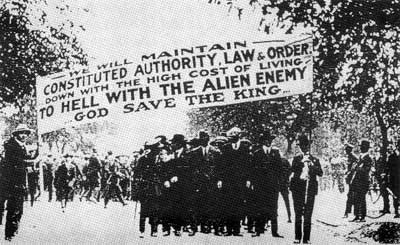
Wednesday, 4 June 1919 - Anti-strike veterans
By this time the sight of 'pro-strike' veterans' daily marches to the legislature prompted those on the other side of the issue to mobilize. Today was one of the largest of the first 'anti-strike' marches by veterans.
For a good essay on the returning soldiers, including a summary of the 'pro-strike' and 'anti- strike' sides see Idionng's The Third Force: Returned Soldiers in the Winnipeg General Strike of 1919 (it's also the image source for the 2 MB Archives photos above).
Wednesday, June 3
Tuesday, 3 June 1919 - Marches Get Larger
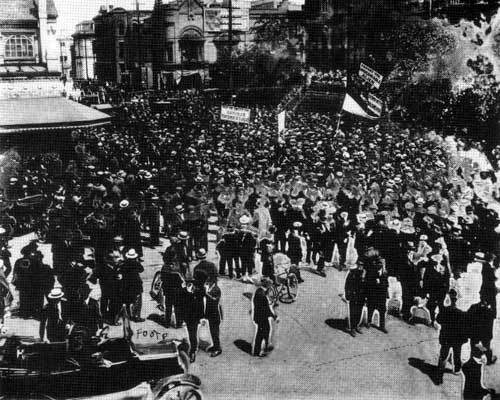
The daily parade of veterans to the Legislature continue:
On June 3 a parade formed again in Market Square, just behind the City Hall, but soon returned to nearby Victoria Park, where Roger E. Bray, a socialist who had become the spokesman for the returned soldiers, announced that the soldiers had met with the Premier also with unsatisfactory results.
source
source
As reported in the New York Times:
Premier Norris of Manitoba and his Cabinet were publicly called on to resign by speakers of the delegation of returned soldiers, strikers, and strike sympathizers, who took possession of the Provincial Legislative Chamber today for the third time
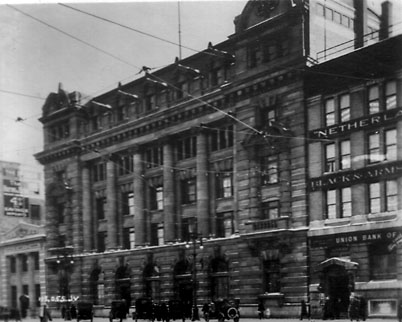
One paragraph in that article mentions that the protesters tore down the sign out front of the Board of Trade building:
One paragraph in that article mentions that the protesters tore down the sign out front of the Board of Trade building:Tuesday, 3 June 1919 - The Newsstand
Western Labor News June 3, 1919
- Declares that Soldiers Mean Business and provides details from yesterday's meeting with the Premier.
- Draft Shakespeare into the movement !

Winnipeg Citizen June 3, 1919

Winnipeg Telegram Strike Edition June 3, 1919
- The Police Commission removes the ultimatum issued to former and new police officers that if that if they do not return to work and / or sign a pledge never to participate in a sympathetic strike (including this one) that they will be dismissed
- Vancouver strikes in sympathy with Winnipeg.
- The following ad appears from the 1000:
- Declares that Soldiers Mean Business and provides details from yesterday's meeting with the Premier.
- Draft Shakespeare into the movement !

Winnipeg Citizen June 3, 1919

Winnipeg Telegram Strike Edition June 3, 1919
- The Police Commission removes the ultimatum issued to former and new police officers that if that if they do not return to work and / or sign a pledge never to participate in a sympathetic strike (including this one) that they will be dismissed
- Vancouver strikes in sympathy with Winnipeg.
- The following ad appears from the 1000:
Tuesday, June 2
Monday, 2 June 1919 - The Newsstand
Western Labor News June 2, 1919
- Appear buoyed by the veteran strikers
-Today's meetings
Winnipeg Citizen June 2, 1919
- An angry story entitled "They shall be known by their acts" takes up the entire front page, lashing out at the labour movement, including strikers and the Labor News.
Winnipeg Telegram Strike Edition June 2, 1919
- Report that 10,000 veteran strikers converged on the Legislature this morning to visit Premier Norris. Led by A.E. Bray they present a petition to Norris demanding: compulsive collective bargaining; withdrawal of ultimatum to Winnipeg Police Force (to return and swear never to participate in a strike); the reinstatement of all provincial workers without discrimination. If he fails to meet these demands, they will call on the government to resign.
- Report that mass meetings and marches are becoming more unruly and "requires only one fool" within the crowd to trigger violence.
- Appear buoyed by the veteran strikers
-Today's meetings
Winnipeg Citizen June 2, 1919- An angry story entitled "They shall be known by their acts" takes up the entire front page, lashing out at the labour movement, including strikers and the Labor News.
Winnipeg Telegram Strike Edition June 2, 1919
- Report that 10,000 veteran strikers converged on the Legislature this morning to visit Premier Norris. Led by A.E. Bray they present a petition to Norris demanding: compulsive collective bargaining; withdrawal of ultimatum to Winnipeg Police Force (to return and swear never to participate in a strike); the reinstatement of all provincial workers without discrimination. If he fails to meet these demands, they will call on the government to resign.
- Report that mass meetings and marches are becoming more unruly and "requires only one fool" within the crowd to trigger violence.
Sunday, May 31
Saturday, 31 May 1919 - Moose Jaw
May 31, 1919 - A member of the executive of the Citizens' Committee of One Thousand delivers an address in Moose Jaw, a city in the midst of its own sympathetic general strike. The discussion was about the inner workings of the "1000" - how it was established and why.
He reiterated that the main purpose of the committee was to keep essential services going, he certainly does not hide his disdain for the strikers and the strike committee:


Above: A transcript of the speech was published as "An address on the subject of the Winnipeg strike, May-June, 1919: Delivered by a member of the Citizens' Committee of One Thousand to a deputation of citizens from Moose Jaw, Sask.: With especial reference to the enunciation therein contained upon the principles of 'collective bargaining'". Full text.
He reiterated that the main purpose of the committee was to keep essential services going, he certainly does not hide his disdain for the strikers and the strike committee:


Above: A transcript of the speech was published as "An address on the subject of the Winnipeg strike, May-June, 1919: Delivered by a member of the Citizens' Committee of One Thousand to a deputation of citizens from Moose Jaw, Sask.: With especial reference to the enunciation therein contained upon the principles of 'collective bargaining'". Full text.
Saturday, 31 May 1919 - The Newsstand
Western Labor News May 31, 1919
Winnipeg Citizen May 31, 1919

Winnipeg Citizen May 31, 1919
Saturday, May 30
Friday, 30 May - The Newsstand
Western Labor News May 30, 1919

Winnipeg Citizen May 30, 1919

Friday, 30 May 1919 - Veterans Speak
Returning veterans have been holding daily demonstrations of their own. Today a march of 4,000 calling for a peaceful end to the strike, including the abolition of the Committee of 1000 and a withdrawal of the ultimatum to the police that they sign pledge to never join a union or be dismissed. When the march reaches the Legislature, 2000 of the men enter the building demanding to see Premier Norris. Source.
See Telegram: "Soldier strikers in Ugly Mood Today"
Friday, May 29
Thursday, 29 May 1919 - The Newsstand
On today's newsstand: The Western Labor News asks What is a Living Wage ? while the Winnipeg Citizen claims that thousands of workers were tricked into striking by Bolsheviks.
The Winnipeg Telegram Strike Edition carries a notice from Police Chief MacPherson that police officers (who did not walk out on strike) must sign a pledge by 1 p.m. tomorrow that they will not organize into a union "or any other organization." The penalty is dismissal.
The Trib and Telegram lay out their news policies during the strike.
Thursday, May 28
Wednesday, 28 May 1919 - The Newsstand
Western Labor News May 28, 1919
Perhaps having two competitors this week has put the Citizen on the defensive. Front page items today include a long article about why they choose to strike and another proclaiming that "95% of people" support the workers.
Winnipeg Citizen May 28, 1919
An open letter to the Citizens of Winnipeg
Winnipeg Telegram Strike Edition May 28, 1919
- Reports that the Committee of 1000 is signing up volunteers to perfrom duties such as garbage collection
Perhaps having two competitors this week has put the Citizen on the defensive. Front page items today include a long article about why they choose to strike and another proclaiming that "95% of people" support the workers.
Winnipeg Citizen
An open letter to the Citizens of Winnipeg
- Reports that the Committee of 1000 is signing up volunteers to perfrom duties such as garbage collection
Wednesday, May 27
Tuesday, 27 May 1919 - The Newsstand Grows
There's a new, old paper on the newsstands today: The Winnipeg Telegram Strike Edition !
Though anti-strike, the paper is not just strike news. It's a smaller version of the regular Telegraph with local and international news, wire features, sports and entertainment. Just like the Winnipeg Free Press, which is also publishing again*.
Western Labor News May 27, 1919
Winnipeg Citizen May 27, 1919
Winnipeg Telegram Strike Edition for May 27, 1919. The first Editorial Page and the following full page ad - "first in a series":
*The Winnipeg Free Press also resumed publishing but it's archives are behind a subscription wall so I cannot link to them on a daily basis.
Today, though, they reported on the decision by city council to fire striking city workers. Notices to fill positions are to be readied. Strikers can reapply for their old jobs but would have to denounce the strike.
Though anti-strike, the paper is not just strike news. It's a smaller version of the regular Telegraph with local and international news, wire features, sports and entertainment. Just like the Winnipeg Free Press, which is also publishing again*.
Western Labor News
Winnipeg Citizen
Winnipeg
*The Winnipeg Free Press also resumed publishing but it's archives are behind a subscription wall so I cannot link to them on a daily basis.
Today, though, they reported on the decision by city council to fire striking city workers. Notices to fill positions are to be readied. Strikers can reapply for their old jobs but would have to denounce the strike.
Tuesday, 27 May 1919
The scope of the strike widens as more cities take sympathetic strike votes.
It was also receiving increased international attention, written extensively in publications like the New York Times. Today's story (pdf):
Tuesday, May 26
Monday, 26 May 1919
The Post Office ultimatum has come and past. Of the hundreds of postal workers on strike only 16 return to work (source). A moral victory for the strikers.
Monday, 26 May 1919 - Hot in the City
Adding to to the tensions, the last week of May 1919 is unseasonably hot. From May 24 to 30 highs are at or above 30 degrees.
Monday, May 25
Sunday, 25 May 1919 - Postal Deadline
Sundays are a day for family. Even during the strike the respective propaganda newspapers took the day off.
Seven thousand workers show up for an evening gathering at Victoria Park. Some may have come to enjoy the cool breeze off the river on a 30 degree day but others came bearing news of an employer's ultimatum.
The Post Office has told it's workers that if they don't show up for work tomorrow at 10:00 a.m. they are terminated, along with any pension they may have earned (source).
Seven thousand workers show up for an evening gathering at Victoria Park. Some may have come to enjoy the cool breeze off the river on a 30 degree day but others came bearing news of an employer's ultimatum.
The Post Office has told it's workers that if they don't show up for work tomorrow at 10:00 a.m. they are terminated, along with any pension they may have earned (source).
Sunday, May 24
Saturday, 24 May 1919 - The Newsstand
Today's Winnipeg Citizen headline: Strike Unjustified; Citizens Must Stand firm
The Citizen is paraphrasing Arthur Meighan, Manitoba M.P. and federal Minister of the Interior, who is in Winnipeg. The citizen quotes him as saying "It is up to the citizens of Winnipeg to stand firm and resist efforts made here to overturn proper authority"
The Western Labor News of May 24, 1919 tells strikers "Don't worry and don't work."
The Citizen is paraphrasing Arthur Meighan, Manitoba M.P. and federal Minister of the Interior, who is in Winnipeg. The citizen quotes him as saying "It is up to the citizens of Winnipeg to stand firm and resist efforts made here to overturn proper authority"
The Western Labor News of May 24, 1919 tells strikers "Don't worry and don't work."
Saturday, May 23
Friday, 23 May 1919 - The Newsstand
Winnipeg Citizen May 23, 1919 Read the full Edition !
Western Labor News May 23, 1919 Read the full edition !
The following is an excerpt from the Toronto Daily Star on this day:
Star Source
Western Labor News May 23, 1919 Read the full edition !
The following is an excerpt from the Toronto Daily Star on this day:Outward Appearances Show No Sign Of Any Big Strike
Toronto Daily Star, 23 May 1919, W.R. Plewman
The strikers have gone pretty far and they have made some mistakes but they have not perpetrated Bolshevism.
The writer came to the city (Winnipeg) understanding that the Strike Committee of Five had inaugurated a reign of terror, preventing willing workers from serving their employers and the public and allowing only a few employers, who would submit to the humiliation of displaying signs "By permission of the Strike Committee" to carry on. It was that idea and the vision of impending Bolshevik horrors that drove nearly all the non-strikers into one camp and made virtually all those who are not manual workers enthusiastic supporters of the offensive now being waged by the Citizen's Committee. But the whole thing is a delusion and a figment of the imagination.
There is no Soviet. There was little or no terrorism.
Toronto Daily Star, 23 May 1919, W.R. Plewman
The strikers have gone pretty far and they have made some mistakes but they have not perpetrated Bolshevism.
The writer came to the city (Winnipeg) understanding that the Strike Committee of Five had inaugurated a reign of terror, preventing willing workers from serving their employers and the public and allowing only a few employers, who would submit to the humiliation of displaying signs "By permission of the Strike Committee" to carry on. It was that idea and the vision of impending Bolshevik horrors that drove nearly all the non-strikers into one camp and made virtually all those who are not manual workers enthusiastic supporters of the offensive now being waged by the Citizen's Committee. But the whole thing is a delusion and a figment of the imagination.
There is no Soviet. There was little or no terrorism.
Star Source
Friday, May 22
Victoria Park
By now, the strike had settled into a bit of a routine. One of those routines were the daily gatherings at Victoria Park. It was a place for workers to meet, share stories, get the latest news, listen to speeches. Later it would also be a starting point for marches that would come later in the strike.
Victoria Park, established in 1894, was located on a stretch of land behind the present day Concert Hall: roughly from the MTC Warehouse down to Waterfront Drive. An aerial photo can be found here.
For more on strike action in Victoria Park.
Victoria Park, established in 1894, was located on a stretch of land behind the present day Concert Hall: roughly from the MTC Warehouse down to Waterfront Drive. An aerial photo can be found here.
For more on strike action in Victoria Park.
Thursday, 22 May 1919 - The Newsstand
Western Labor News May 22, 1919
- Repeals the need for "those cards":

Winnipeg Citizen May 22, 1919
- Claims moral victory in strike card issue:
- Examines the One Big Union vote workers will be taking later in the summer. Concludes that it "...proves there is a revolutionary movement on..." and that "...unless Winnipeg throttles this general strike idea right here an now, Winnipeg herself will be throttled again on July 1st."
The Alberta Non-Partisan editorializes How the Might Have Fallen, referring to the major daily newspapers which, to date, have not yet resumed publishing. It muses that it dismisses the popular myth "...that Labour can get along without capital but that Capital cannot get along without Labour".
- Repeals the need for "those cards":

Winnipeg Citizen May 22, 1919
- Claims moral victory in strike card issue:
- Examines the One Big Union vote workers will be taking later in the summer. Concludes that it "...proves there is a revolutionary movement on..." and that "...unless Winnipeg throttles this general strike idea right here an now, Winnipeg herself will be throttled again on July 1st."
The Alberta Non-Partisan editorializes How the Might Have Fallen, referring to the major daily newspapers which, to date, have not yet resumed publishing. It muses that it dismisses the popular myth "...that Labour can get along without capital but that Capital cannot get along without Labour".Thursday, May 21
Wednesday, 21 May 1919 - The Newsstand
Wednesday, May 20
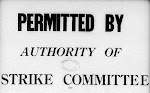
"Permitted by Authority of Strike Committee"
A symbol of the strike that angered the Citizens' Committee of 1000 was the "By Authority of the Strike Committee" permit cards issued by the Strike Committee to those doing what they deemed "essential services".
In speeches and interviews the "1000" denounced the signs. Here is how they felt, from the pages of their own newspaper:
Tuesday, 20 May 1919 - Brandon's Sympathetic Strike Growing
Brandon workers chose May 20 as the day for a sympathetic strike.
Yesterday 125 CP workers walked off the job, today 100 CN rail workers left. Many more are expected as the days go by.
Brandon Strike Resources:
- Brandon, 1919: Labour and Industrial Relations in the Wheat City in the Year of the General Strike
- Let us rise! : a history of the Manitoba labour movement
Yesterday 125 CP workers walked off the job, today 100 CN rail workers left. Many more are expected as the days go by.
Brandon Strike Resources:
- Brandon, 1919: Labour and Industrial Relations in the Wheat City in the Year of the General Strike
- Let us rise! : a history of the Manitoba labour movement
Tuesday, May 19
Monday, 19 May 1919
The Winnipeg Citizen newspaper begins publication. It is an organ of the Citizen's Committee of One Thousand.
Read today's edition.
Monday, 19 May 1919
Minutes from today's meeting of the Winnipeg Strike Committee shows the impact of the "By Authority of Strike Committee Cards."
Monday, 19 May 1919 - The Newsstand
Monday, May 18
May 18 - The Strike Committee
The Winnipeg Strike Committee:

The Winnipeg Strike committee was created by representatives of the unions that were part of the Trades and Labour Council. The were organized into subcommittees and an executive Central Strike Committee of five. This Central Committee was the decision making body for labour, and thus the city, during the strike.

The Winnipeg Strike committee was created by representatives of the unions that were part of the Trades and Labour Council. The were organized into subcommittees and an executive Central Strike Committee of five. This Central Committee was the decision making body for labour, and thus the city, during the strike.
Sunday, 18 May 1919 - Mayor Gray: Zero Tolerance
Proclamations by Mayor Gray on May 18th outlining a couple of zero tolerance matters:
"Let me make this absolutely clear. If the food supplies and the protection of life and property are not maintained I shall take whatever action may be necessary to secure them and maintain the authority of the government as it is established by the voice of the people".
Subscribe to:
Posts (Atom)