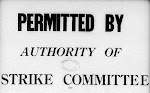
Read a letter from Great War Veterans Association to the Winnipeg Trades and Labor Council and Citizens' Committee of One Thousand Re: the definition of "undesirable aliens"
Monday, June 15

Sunday, 15 June 1919 - The Newsstand
The only paper to publish today is the Western Labour News.
Some stories:
- Is Winnipeg Ruined ? The editors give their take answering the question that some businessmen have floated. That this will be a black eye for Winnipeg that will prevent business from coming or expanding.
- An account of last night's 8,000 strong meeting in Victoria Park. J.S. Woodsworth, and W.A. Pritchard were two of the presenters.
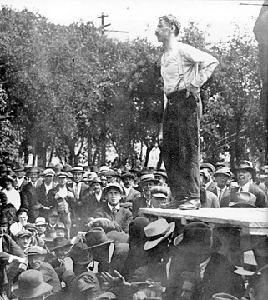 Bray addresses supporters
- A reminder that the only barbers in town who are not scabs are the ones working in the basement of the Labour Temple.
Some stories:
- Is Winnipeg Ruined ? The editors give their take answering the question that some businessmen have floated. That this will be a black eye for Winnipeg that will prevent business from coming or expanding.
- An account of last night's 8,000 strong meeting in Victoria Park. J.S. Woodsworth, and W.A. Pritchard were two of the presenters.
Bray addresses supporters- A reminder that the only barbers in town who are not scabs are the ones working in the basement of the Labour Temple.
Sunday, June 14
Saturday, 14 June 1919 - The Newsstand
- More details on the resolution passed at last night's successful strike vote of the railway firemen and engineers locals. It was forwarded to the city today.
 Winnipeg Citizen for June 14
- Interviews a 'mole' ! William Bathie, said to have been a strike committee 'insider' who left because revolution was at the bottom of the strike and that German money was funding it, speaks to The Citizen.
- The N.Y.-based Brotherhood of Railway Trainmen orders their members back to work. The Telegram has a copy of the memo sent to the local leadership. Their concern is that one city can disrupt existing agreements with rail companies across the continent.
(For more on some of the US rail fraternities of the day).

Saturday, June 13
13 June 1919 - Railway Men Now Out
Due to international affiliations, some locals were asked not to strike by their umbrella organizations. In Winnipeg that included railway car men and typographers.
Today, the railway men split with their International Brotherhood and joined the general strike.
The New York Times reports:
Railroad men Now Out In Winnipeg; Nevertheless Mayor Gray Intimates Strike Settlement Is Coming Soon.
WINNIPEG, Jun 13 (NY Times) - Settlement of the Winnipeg strike this week was intimated this afternoon by Mayor Gray. When he was asked if the latest conciliation movement was succeeding he said: "I may have big news for you within twenty-four hours." (more - pdf)
WINNIPEG, Jun 13 (NY Times) - Settlement of the Winnipeg strike this week was intimated this afternoon by Mayor Gray. When he was asked if the latest conciliation movement was succeeding he said: "I may have big news for you within twenty-four hours." (more - pdf)
Friday, 13 June 1919 - The Newsstand
Western Labor News for June 13, 1919
- A "Birdseye View" of the strike
- Labor gets wind that "ugly action" is contemplated to end the strike.
Winnipeg Citizen June 13, 1919
- Ominous headline reads An Awakening is Coming.
Winnipeg Telegram Strike Edition June 13, 1919
- An editorial says that the time has come to read the riot act now that blood has been shed:

Thursday, 12 June 1919 - The Newsstand
Western Labor News for June 12, 1919
- Rioting at Portage and Main. Mayor quoted as saying "By God, I'm responsible for law and order and I'll maintain it"
- An open letter from J.S. Woodsworth to Winnipeg labour. "In reality, this strike has nothing to do with Revolution. It is an attempt to meet a very pressing and immediate need....They are out for higher wages."
Winnipeg
- Runs a Chicago Tribune Editorial that "Canada's sympathetic strike is losing ground"
Winnipeg
- Police move in to arrest one of the "aliens" involved in the Higgins and Main riot yesterday, the one that saw a constable shot. As the police were leading him to the paddy wagon a crowd intervened and the man set loose.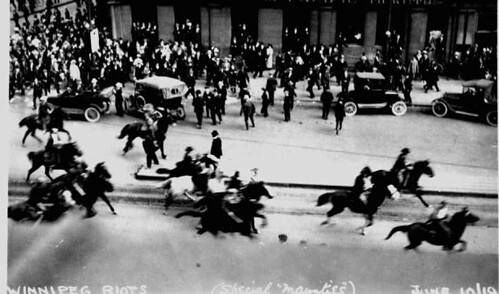
- Police move in to arrest one of the "aliens" involved in the Higgins and Main riot yesterday, the one that saw a constable shot. As the police were leading him to the paddy wagon a crowd intervened and the man set loose.
Friday, June 12
Thursday, June 11
Wednesday, 11 June 1919 - The Newsstand
The papers are all about last night's rioting...
Western Labor News

- Last night saw "A Riot Born of Revolution"
Winnipeg
 - A Telegram reader upset by 'bohunk' riots:
 A school lesson on Fred Coppins' injuries can be found here in pdf. It includes excerpts from newspaper reports.
The New York Times for June 11
- "Riot and violence broke loose on the streets of Winnipeg today. For three hours the strikers fought a pitched battle with the special constabulary in the heart of the city, at Main Street and Portage Avenue, while from windows and roofs of office buildings for three blocks Winnipeg looked on". (full article in pdf)
Western Labor News

- Last night saw "A Riot Born of Revolution"
 - A Telegram reader upset by 'bohunk' riots:
 A school lesson on Fred Coppins' injuries can be found here in pdf. It includes excerpts from newspaper reports.
The New York Times for June 11
- "Riot and violence broke loose on the streets of Winnipeg today. For three hours the strikers fought a pitched battle with the special constabulary in the heart of the city, at Main Street and Portage Avenue, while from windows and roofs of office buildings for three blocks Winnipeg looked on". (full article in pdf)
Wednesday, 11 June 1919 - Riot and Proclamation
 The proclamation was issued after a riot last night.
A number of people were hurt including recently returned V.C. Frederick Coppins, acting as a special mounted constable. It's hard to tell what exacly happened from reading the newspapers (also see today's Newsstand).
 A Telegram article says that he was both "...dragged from his horse by aliens who started murderously kicking him" but two paragraphs further down "... as he was turning, the horse stumbled and fell, throwing Coppins" and then he was beaten.
As for his condition, The Citizen reports that he is dying in hospital and that "He was not expected to make it until morning". The Telegram is more upbeat "Unless complications set it doctors hold out hope for his recovery".
The Citizens' Committee have this ad about Coppins in today's Telegram:

Another Special Constable injured is T.S. Morrison of Ruby Street who is recovering in General Hospital from a gunshot wound to the leg. The Telegram says that a man driving by Higgins and Main came across a scuffle between a crowd and constables. He pulled over and shot with the intent to stop the fight and protect the officers. Accounts say that teh fighting did stop !
One of the three 'Austrian aliens' involved in the brawl with offiers was beaten with police batons "having his head severely damaged".
Wednesday, June 10
Tuesday, 10 June 1919
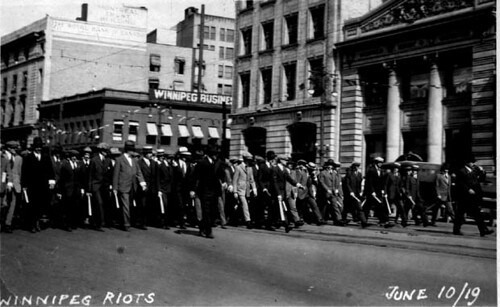
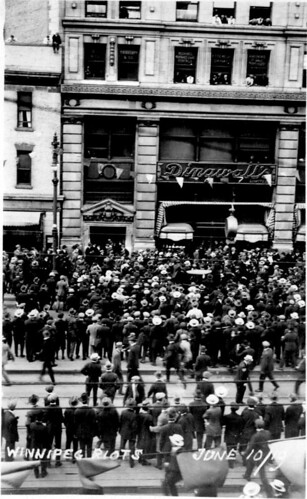
Here's what it looked like on the streets of Winnipeg today. The dismissal of the police force has added to the tension and the first open conflicts between strikers and police are noted. (Images from Manitobia and Tribune Archives.)


Tuesday, 10 June 1919 - The Chief goes, too
Chief Donald MacPherson, a 15-year veteran of the Winnipeg Police Department and chief since 1911, is ordered to take a three month administrative leave to allow for a new acting chief to 'reorganize'. MacPherson refuses and, as with the rest of his force, is dismissed.
The official statement from the Police Commission:
 The new acting chief Chris H. Newton is a 20-year member of the force and was deputy chief under MacPherson. According to a Winnipeg Free Press story he had been offered the position of chief in 1911 but declined, making way for MacPherson.
For more on the Winnipeg Police during the Strike.

The official statement from the Police Commission:
 The new acting chief Chris H. Newton is a 20-year member of the force and was deputy chief under MacPherson. According to a Winnipeg Free Press story he had been offered the position of chief in 1911 but declined, making way for MacPherson.
For more on the Winnipeg Police during the Strike.
Tuesday, 10 June 1919 - A few good men
The following ad is in today's Winnipeg Free Press. Note that you apply to the now deposed Chief Constable !
 Despite the offer to re-hire police officers if thy denounce their association and refuse to ever strike, only 22 of the original members sign back onto the force. In the night a new force of special constables, referred to as "specials", are sworn in.


 Despite the offer to re-hire police officers if thy denounce their association and refuse to ever strike, only 22 of the original members sign back onto the force. In the night a new force of special constables, referred to as "specials", are sworn in.
Tuesday, 10 June 1919 - The Newsstand
Western Labor News
Winnipeg Citizen
Winnipeg
Winnipeg Citizen
Tuesday, June 9
9 June 1919 - Out With the Force
Tempers have been simmering at city hall over the police force.
Officials fear that the unionized police force may walk out in sympathy with the general strike. The addition of special constables and federal police to city streets has caused tensions between forces.
The Police Commission refused to deal with the police union and issued an ultimatum: that members of the force must sign a declaration renouncing their union membership and that they will not participate in a general strike. The members wouldn't sign the declaration and, as a result, the entire 277 member Winnipeg Police Force is fired by Resolution of Dismissal passed by council today:

Also see Winnipeg Telegram Police Force Fired
Officials fear that the unionized police force may walk out in sympathy with the general strike. The addition of special constables and federal police to city streets has caused tensions between forces.
The Police Commission refused to deal with the police union and issued an ultimatum: that members of the force must sign a declaration renouncing their union membership and that they will not participate in a general strike. The members wouldn't sign the declaration and, as a result, the entire 277 member Winnipeg Police Force is fired by Resolution of Dismissal passed by council today:

Also see Winnipeg Telegram Police Force Fired
Monday, 9 June 1919 - The Newsstand
Western Labor News for June 9, 1919
- The "Greatest meeting ever held" in Winnipeg last night as Woodsworth addresses 10,000 at Victoria Park.
- Under the headline "The Winnipeg Revolutionary Strike" a full 12 pages of text outlining the Citizens' position on the strike.
Winnipeg Telegram Strike Edition for June 9, 1919
- Premier Norris' Cabinet calls for the Alien Act to be passed by parliament to deal with the "foreign agitator and alien enemy of Canada"
- The Walker Theatre closes for June due to the stage hand strike.
- More want ads appear looking for replacement workers.
Monday, June 8
Sunday, 8 June 1919 - Psst...looking for a job ?!
The papers don't publish today but if you have yesterday's Telegram look at all the jobs on the go now - permanent ones, too:
 They're not hiring for Grand Beach as the place isn't ready for summer visitors yet due to the strike:

 They're not hiring for Grand Beach as the place isn't ready for summer visitors yet due to the strike:
Sunday, June 7
Saturday, June 6
Friday, 6 June 1919 - Law and Order
Government leaders are putting into place new law and order provisions.
At a meeting in the premier's office yesterday that included Premier Norris, General Huntley Ketchen commander of military forces in Manitoba, Commissioner Aylesworth Perry of the NWMP and other authorities "plans were completed for the introduction of military rule in Winnipeg". Discussions also included having the military delivery of food to rural areas.
 Ketchen
 Perry
Perry
Ketchen is a tough-talker declaring that he will restore order. He feels that the current patchwork of regular police, volunteer police and special constables is not ideal for keeping order and that there are "too many mistakes are being made" and that mistakes could cost lives.
After yesterday's declaration by Mayor Gray forbidding mass gatherings, it is noted that the Specials are ready to break up street parades. When it was rumoured that a march might be called for today a Telegraph reporter quotes the mayor as saying "Tell the O.C. to have all of his mean ready and the mounted police in their saddles".
A parade never materialized.
At a meeting in the premier's office yesterday that included Premier Norris, General Huntley Ketchen commander of military forces in Manitoba, Commissioner Aylesworth Perry of the NWMP and other authorities "plans were completed for the introduction of military rule in Winnipeg". Discussions also included having the military delivery of food to rural areas.
KetchenPerryKetchen is a tough-talker declaring that he will restore order. He feels that the current patchwork of regular police, volunteer police and special constables is not ideal for keeping order and that there are "too many mistakes are being made" and that mistakes could cost lives.
After yesterday's declaration by Mayor Gray forbidding mass gatherings, it is noted that the Specials are ready to break up street parades. When it was rumoured that a march might be called for today a Telegraph reporter quotes the mayor as saying "Tell the O.C. to have all of his mean ready and the mounted police in their saddles".
A parade never materialized.
Friday, June 5
Friday, 6 June 1919 - The Newsstand
- Today's front page shows how large, and eventful, the marches are becoming. One story is of tells of "Ten Thousand Marchers" and that a "clash" was narrowly averted.
- Another story openly accuses the Committee of 1000 of having "armed thugs" watching the marches ready to cause trouble in the crowd. It tells of one such man being arrested and the mayor chasing the paddy-wagon down Main street demanding that the man be released from custody. A scuffle ensues when the Mayor leaves his car.
The front page also carries this notice for strikers:

Winnipeg Citizen
- Again uses the "child murderer" tag to describe the Strike Committee, accusing them of wooing dairy workers to consider strike action just days after a 'truce' was reached allowing the delivery of milk to resume.
- They, too, tell the story of the Mayor intervening in the arrest of an armed man on Main Street. Apparently, the man was a federal officer.
- Carries the headline "Mayor Gray is Assaulted", also recounting the arrest story.
- One of the strike's prominent women leaders, Helen Armstrong, appeared in court today after an altercation between strikers and newsies.
 - Today's editorial "The Influx of Undesirables" says that the increasing unrest of the marches is attracting "professional agitators and crooks" from across the country to Winnipeg. The "riff-raff" of various vices are coming because they know there is no police force in place.
The New York Times
- "Winnipeg Quieter with Soldiers' Aid"
The strengthening of Winnipeg's police force by 1,000 war veterans as special constables caused an increase in minor strike disturbances today. There were personal encounters but no serious demonstrations occurred.
Thursday, 5 June 1919 - The Great War Veterans' Association Takes Sides
Tensions have been growing within the ranks of returned Veterans over their position on the strike. By this time, there are both pro and anti strike Veteran groups marching.
 The largest umbrella group for the men is the Great War Veterans' Association. It was established in 1917 after a number of failed or modest attempts by the government to assist soldiers upon their return:
Officially, the GWVA was neutral but that changed today. At a boisterous meeting at the GWVA hall the following resolution was put forth from the floor over the attempts of the chair to overrule it.
 The motion passed with the required majority. The GWVA is now on-side with the strike.
The next day it was announced that the GWVA executive voted to cancel all meetings of the organization until fourteen days after the strike was declared over.
Also see "From Great War Veterans' Association to the Legion"
 The largest umbrella group for the men is the Great War Veterans' Association. It was established in 1917 after a number of failed or modest attempts by the government to assist soldiers upon their return:
"... the returning soldiers began to create their own organizations. The most powerful of these was the Great War Veterans' Association. Through these organizations, the soldiers pressured the government to give preference to veterans when hiring and to increase pensions for common soldiers, widows, and the disabled". source
Officially, the GWVA was neutral but that changed today. At a boisterous meeting at the GWVA hall the following resolution was put forth from the floor over the attempts of the chair to overrule it.
 The motion passed with the required majority. The GWVA is now on-side with the strike.
The next day it was announced that the GWVA executive voted to cancel all meetings of the organization until fourteen days after the strike was declared over.
Also see "From Great War Veterans' Association to the Legion"
Subscribe to:
Posts (Atom)