Wednesday, May 27

Tuesday, 27 May 1919 - The Newsstand Grows

There's a new, old paper on the newsstands today: The Winnipeg Telegram Strike Edition !

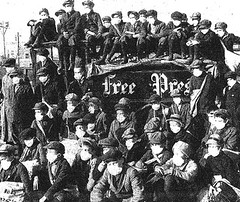
Though anti-strike, the paper is not just strike news. It's a smaller version of the regular Telegraph with local and international news, wire features, sports and entertainment. Just like the Winnipeg Free Press, which is also publishing again*.

Western Labor News
May 27, 1919

Winnipeg Citizen
May 27, 1919

Winnipeg
Telegram Strike Edition for May 27, 1919. The first Editorial Page and the following full page ad - "first in a series":
*The Winnipeg Free Press also resumed publishing but it's archives are behind a subscription wall so I cannot link to them on a daily basis.

Today, though, they reported on the decision by city council to fire striking city workers. Notices to fill positions are to be readied. Strikers can reapply for their old jobs but would have to denounce the strike.

Tuesday, 27 May 1919

The scope of the strike widens as more cities take sympathetic strike votes.

It was also receiving increased international attention, written extensively in publications like the New York Times. Today's story (pdf):

Tuesday, May 26

Monday, 26 May 1919 - The Newsstand

Western Labor News for May 26, 1919


Winnipeg Citizen for May 26, 1919

Monday, 26 May 1919

The Post Office ultimatum has come and past. Of the hundreds of postal workers on strike only 16 return to work (source). A moral victory for the strikers.

Monday, 26 May 1919 - Hot in the City

Adding to to the tensions, the last week of May 1919 is unseasonably hot. From May 24 to 30 highs are at or above 30 degrees.

Monday, May 25

Sunday, 25 May 1919 - Postal Deadline

Sundays are a day for family. Even during the strike the respective propaganda newspapers took the day off.

Seven thousand workers show up for an evening gathering at Victoria Park. Some may have come to enjoy the cool breeze off the river on a 30 degree day but others came bearing news of an employer's ultimatum.

The Post Office has told it's workers that if they don't show up for work tomorrow at 10:00 a.m. they are terminated, along with any pension they may have earned (source).

Main Post Office, Portage and Garry

Sunday, May 24

Saturday, 24 May 1919 - The Newsstand

Today's Winnipeg Citizen headline: Strike Unjustified; Citizens Must Stand firm


The Citizen is paraphrasing Arthur Meighan, Manitoba M.P. and federal Minister of the Interior, who is in Winnipeg. The citizen quotes him as saying "It is up to the citizens of Winnipeg to stand firm and resist efforts made here to overturn proper authority"


The Western Labor News of May 24, 1919 tells strikers "Don't worry and don't work."

Saturday, May 23

Friday, 23 May 1919 - The Newsstand

Winnipeg Citizen May 23, 1919 Read the full Edition !

Western Labor News May 23, 1919 Read the full edition !

The following is an excerpt from the Toronto Daily Star on this day:

Outward Appearances Show No Sign Of Any Big Strike
Toronto Daily Star, 23 May 1919, W.R. Plewman

The strikers have gone pretty far and they have made some mistakes but they have not perpetrated Bolshevism.

The writer came to the city (Winnipeg) understanding that the Strike Committee of Five had inaugurated a reign of terror, preventing willing workers from serving their employers and the public and allowing only a few employers, who would submit to the humiliation of displaying signs "By permission of the Strike Committee" to carry on. It was that idea and the vision of impending Bolshevik horrors that drove nearly all the non-strikers into one camp and made virtually all those who are not manual workers enthusiastic supporters of the offensive now being waged by the Citizen's Committee. But the whole thing is a delusion and a figment of the imagination.

There is no Soviet. There was little or no terrorism.

Star Source

Friday, May 22

Victoria Park

By now, the strike had settled into a bit of a routine. One of those routines were the daily gatherings at Victoria Park. It was a place for workers to meet, share stories, get the latest news, listen to speeches. Later it would also be a starting point for marches that would come later in the strike.

Victoria Park, established in 1894, was located on a stretch of land behind the present day Concert Hall: roughly from the MTC Warehouse down to Waterfront Drive. An aerial photo can be found here.

For more on strike action in Victoria Park.

Strikers at Victoria Park

Thursday, 22 May 1919 - The Newsstand

Western Labor News May 22, 1919

- Repeals the need for "those cards":


Winnipeg Citizen
May 22, 1919

- Claims moral victory in strike card issue:

- Examines the One Big Union vote workers will be taking later in the summer. Concludes that it "...proves there is a revolutionary movement on..." and that "...unless Winnipeg throttles this general strike idea right here an now, Winnipeg herself will be throttled again on July 1st."
The Alberta Non-Partisan editorializes How the Might Have Fallen, referring to the major daily newspapers which, to date, have not yet resumed publishing. It muses that it dismisses the popular myth "...that Labour can get along without capital but that Capital cannot get along without Labour".

Thursday, May 21

Wednesday, 21 May 1919 - The Newsstand

The papers compete for the hearts and minds of Winnipeggers:

Western Labor News May 21, 1919

Winnipeg Citizen May 21, 1919

Wednesday, May 20

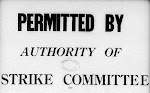
"Permitted by Authority of Strike Committee"

A symbol of the strike that angered the Citizens' Committee of 1000 was the "By Authority of the Strike Committee" permit cards issued by the Strike Committee to those doing what they deemed "essential services".

In speeches and interviews the "1000" denounced the signs. Here is how they felt, from the pages of their own newspaper:

Tuesday, 20 May 1919 - Brandon's Sympathetic Strike Growing

Brandon workers chose May 20 as the day for a sympathetic strike.

Yesterday 125 CP workers walked off the job, today 100 CN rail workers left. Many more are expected as the days go by.

Workers at Brandon Implement and Machinery c 1913

Brandon Strike Resources:
- Brandon, 1919: Labour and Industrial Relations in the Wheat City in the Year of the General Strike
- Let us rise! : a history of the Manitoba labour movement

Tuesday, 20 May 1919 - The Newsstand

Western Labor News May 20, 1919

Winnipeg Citizen May 20, 1919

Tuesday, May 19

Monday, 19 May 1919

The Winnipeg Citizen newspaper begins publication. It is an organ of the Citizen's Committee of One Thousand.

Read today's edition
.

Monday, 19 May 1919

Minutes from today's meeting of the Winnipeg Strike Committee shows the impact of the "By Authority of Strike Committee Cards."

Monday, 19 May 1919 - The Newsstand

Western Labor News May 19, 1919

Winnipeg Citizen May 19, 1919

National Wire Story:


Monday, May 18

May 18 - The Strike Committee

The Winnipeg Strike Committee:


The Winnipeg Strike committee was created by representatives of the unions that were part of the Trades and Labour Council. The were organized into subcommittees and an executive Central Strike Committee of five. This Central Committee was the decision making body for labour, and thus the city, during the strike.

Sunday, 18 May 1919 - Mayor Gray: Zero Tolerance

Proclamations by Mayor Gray on May 18th outlining a couple of zero tolerance matters:

"Let me make this absolutely clear. If the food supplies and the protection of life and property are not maintained I shall take whatever action may be necessary to secure them and maintain the authority of the government as it is established by the voice of the people".

Sunday, May 17

May 17 - The Newsstand

The New York Times reports (see full pdf):

WINNIPEG STRIKE SPREADS FURTHER; Telegraphers Tie Up Wire Service and Railway Men May Join Walkout.

WINNIPEG, Man., May 17.--Reports were current tonight, the third of the general strike involving eighty unions and 30,000 men and women, that the Winnipeg locals of the three great railroad brotherhoods were considering the advisability of joining the strikers. It was also reported that stockyards employes would walk out Monday.

May 17 - Citizens' Committee of 1000

May 17, 1919 - The Citizens' Committee of One Thousand is set up by business leaders to counteract the Strike Committee.

Citizens' Committee of One Thousand, source.

The main goal of the 1000 is to provide essential services to the city while workers are off the job. In their first official statement they give themselves a wider task:

The Citizens Committee of Winnipeg has taken steps to form itself into a permanent organization for the purpose of arousing Dominion-wide interest in the necessity of upholding proper respect for the law and to combat the Bolshevistic propaganda which is being so industriously sown in Western Canada.

Official Statement

Volunteers "man" the pumps

Citizens' Committee HQ

Saturday, May 16

May 16 - New York Times : Winnipeg is Tied Up

From the N.Y. Times:

Friday, 16 May 1919

Today's Western Labour News proudly proclaims: Workers Back Strikers to the Limit. General Strike Overwhelmingly Supported.

On the front page of today's Free Press is a quote from Thomas Roden, president of the Toronto branch of the Canadian Manufacturers' Association. He made the comments about the Winnipeg situation at their annual meeting which took place yesterday.:

  " In the matter of the present strike of the metal trades, no sensible man can possibly sympathize with their demands. The position of the metal workers is one of the most extraordinary positions' ever taken, and can only be taken by people who are desperate to obtain some demand which they know to be unjust.

"The demand for an 8-hour day is only a play upon the sentiment of the times. It is true some trades
have an 8-hours day. The printing trades have an 8-hour day, but it means a 48-hour week to them.
These people want a 44-hour week, although it may be suicidal to Canadian-industry."

Friday, May 15

Thursday, 15 May 1919 - Day of Action

May 15, 1919, Winnipeg Tribune

7:00 am - As the night shift ends for 500 government telephone operators there are no workers to replace them. These women begin the Winnipeg General Strike four hours earlier than the 11:00 am call and communications within the city soon come to a stand still.

8:00 am - The Free Press hits the streets with a font page appeal from Mayor Gray to all citizens asking for for calm:


11:00 am - As scheduled, factories, office buildings, fire halls, workshops, retail outlets, garages begin to empty. By lunchtime, 94 unions walk of the job, approximately 25,000 employees.

Thursday, May 14

Wednesday, 14 May 1919 - Zero Hour is Near

The headline in the Free Press:


The Mayor and Premier express concern at the vote and meet today at 2 pm with representatives from labour and business to seek a compromise.

That meeting is unsuccessful and by the end of day Robinson was contacting senior representatives, such as the city electrician, to inform them that the strike was on:


Mayor Gray sends a lengthy telegram to the acting premier Sir Thomas White and Federal Labour Minister Gideon Robertson summing up the situation and requesting assistance:

Wednesday, May 13

Tuesday, 13 May 1919 - The Results

Though not all unions have cast their ballots yet, a majority have and the results of the strike vote are officially announced.

At the end of the Trades and Labour Council meeting, Alderman E. Robinson, who also happens to be the secretary of the Council, reads the following statement:

“A General Strike has been called of all organizations affiliated with the Trades and Labor Council.

The Strike will take effect at 11 o’clock on Thursday morning. Every organization but one has voted overwhelmingly in favour of strike, and the biggest strike in the history of Winnipeg will take place as above stated.

No exceptions are anticipated in this strike. All public Utilities will be tied up in order to enforce the principle of collective bargaining.”


Later it would be made public that the vote count was 11,000 to 500 in favour of action.

The mayor and premier are on-hand to hear the results.

Tuesday, May 12

May 12

The results are coming in and a majority of unions have so far voted in favour of strike: bricklayers; jewellery workers; electrical workers; pressmen. The only exception so far is the typographical union, on the request of it's international arm.

Voting will continue over the next two days.

Monday, May 11

Sunday, 11 May 1919 - Voting Day

Voting begins today for Winnipeg Trades Council members.

They are asked whether or not they support a general strike in sympathy to the building and metal trades.

Wednesday, May 6

Tuesday, 6 May 1919

The Winnipeg Trades and Labour Council announce that they will hold a city-wide strike vote of other organized workers on May 11th.

Saturday, May 2

Friday, 2 May 1919 - Metal workers set to go

The metal trades union have been negotiating since April for a nine hour working day and recognition of their trade union.

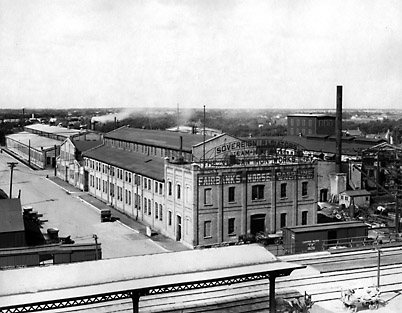
Vulcan Iron Works c 1920

It's rumored that the larger employers in town rejected their demands, while five smaller shops accepted. In the end, the large shops win the day.

Winnipeg's metal trades workers are set to join the building trades on the picket line.

Friday, May 1

Thursday, 1 May 1919

The first edition of the One Big Union Bulletin is published by the "One Big Union Provincial Executive of Manitoba". It gives a rundown of what was happening in the OBU movement in other North America cities and reminds Winnipeg workers that:

Now that the ballots are being distributed in Manitoba, let every
member of organized labor see to it that he casts his vote in order that a true
expression of the ideas of the rank and file can be registered, and let it be a
glorious success for the One Big Union.

To read the full bulletin.
For background on the vote see March 13 entry

Thursday, 1 May 1919 - Construction Workers Set to Go

Just after midnight the results of the builders' trades strike vote is announced: 1,199 in favour to 74 against. At 8 a.m. approximately 1,400 construction workers walk off the job.

Streetcar workers also vote in favour to strike, (900 to 79), but for the time-being will remain on the job.

Thursday, 1 May 1919

Showing that good fortune can be had in a bad situation, Ryan Agency offers Strike and Riot insurance on the front page of the Manitoba Free Press !

Thursday, April 30

30 April 1919

 April 30, 1919, Manitoba Free Press

Talks between the Winnipeg Building Trades Council and the Winnipeg Builders' Exchange fail.

Workers are looking for pay increases to make up for what was lost due to wartime inflation, about 20 cents per hour, depending on position. The Builders' Exchange presents a single proposal not open to negotiation. The increase presented is believed to be in the five to ten cent range.

A strike vote is held and the decision is to strike.

Tuesday, April 28

28 April 1919

Labour unrest continues in Manitoba

Civic workers meet with other labour groups in what the Brandon Sun calls “... the biggest gathering of labour ever held in the city.” 

"The general idea ... was that all the labour here should get into one big union, which would take in all classes of labourers and so unify the whole that they would have a great strength".

For more on Brandon’s 1919 labour unrest.

Friday, April 24

April 24

Both the metal and building trades unions present their demands to their respective employers.

The metal trades want a 17 to 30 cent per hour increase, depending upon position, and a 44 hour work week. The building trades want an increase of around 20 cents per hour with a 44 hour work week and recognition of their trade union.

Sunday, April 12

April 12

One of the many unemployed Veterans' parades in Winnipeg at the time.

Wednesday, April 1

April 1

As labour's militancy grew, so did the suspicions of government.

The federal government had the The Royal North-West Mounted Police involved in espionage:

"...by April, 1919 the R.N.W.M.P. had organized a highly successful undercover intelligence operation in western Canada. Secret agents and detectives had managed to penetrate every important radical union and political party. Some of them had acquired the confidence of union leaders. Their reports gave a detailed account of the activities of the radicals, their plans, speeches and movements. These were carefully scrutinized at the C.I.B. office in Regina and forwarded to Ottawa for the information of Rowell [the president of the Privy Council, and Minister in charge of the R.N.W.M.P.] and other cabinet ministers. The government was being fully informed, as it had requested."

Quote from S.W. Horrall and quoted in Canadian National Security: Legislations vs. Practices 1919-1946 by J. Bennet

Friday, March 13

March 13, 1919

The three-day Western Labour Conference begins in Calgary.


The main item discussed was the creation of "One Big Union." 

It was supported by many labour leaders as amalgamating all workers under one umbrella would allow for greater bargaining power and strike impact. 

It was a controversial proposal. Of course, the business community and government did not did not like the idea of an "all or nothing" labour force. Even within labour, there were many who were fiercely loyal to their respective trade unions and did not want to give them up.


On the first day of the conference R. J. Johns of Winnipeg, chairman of the policy committee, introduced a series of resolutions for the creation of O.B.U.. 

It was decided that workers would vote in June as to whether they wanted to join or not.

An advance issue of the Western Labour News was published on April 4, 1919 containing the conferences report of proceedings.

For more see maniobia.com: "The One Big Union."

Thursday, March 5

Context: The State of Labour


Labour unrest did not come to Winnipeg out oft eh blue. For years, labour action had been mounting in cities around the world, from Limerick to Liverpool, New York to Seattle.


 Source: Kealey, p 16

Vancouver already had a one-day general strike in August 1918. February 1919's Seattle General Strike, (also), saw 100,000 people walk off the job and is actually considered the first "general strike" the U.S. ever had. Hundreds of strikes also took place in Canada in the years preceding 1919.


1906 streetcar strike F36b


Some say that the seeds of the General Strike were sown in 1906 during the bitter Winnipeg Streetcar Strike (page 15). Other industries such as textiles and metal workers struck on and off as well.
The largest labour action prior to the General Strike came in May 1918 after city council refused to meet wage demands by civic employees. Streetcar workers, watermen, telephone operators and the like walked off the job. Other unions, such as construction workers, struck in sympathy. Before others could join in a settlement was reached.


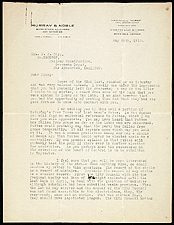
The letter above is between two labour leaders discussing that 1918 strike and the state of labour in the city at the time. Another great source is Manitobia.com "Roots of the Strike" which contains other pamphlets and photos leading up to 1919.

Wednesday, March 4

Context: Winnipeg in 1917 - 1919

Winnipeg's economy fared pretty well through the war years as her factories, farms and transportation network helped produce and ship many of the goods and people that kept the war machine going. Local infrastructure projects such as the Provencher Bridge, Aqueduct and Legislative Building continued, ensuring more jobs on the home front.

The major economic downside was inflation. Nationally it sat at 18% in 1917 and 13% in 1919. Wages, however, did not rise at all during this time.

When the Armistice was announced soldiers did not return from Europe right away. For most it took months. The poor living conditions that soldiers were forced to live in sparked tensions and even a Royal Commission. At one Welsh camp holding 17,000 Canadian soldiers waiting to be repatriated the conditions led to a riot / mutiny in which five Canadian soldiers were killed.

On a happier note, though, here's NFB video footage of some "lads" finally boarding a ship to come home.

Spanish Flu
As the war wound down and repatriation began there was another scourge that soldiers and civilians alike had to deal with: the "Spanish" Flu epidemic of 1918-19. Believed to have originated in U.S. military hospitals, it was brought to Europe by troops and fanned across the continent. As soldiers returned home they brought it back to every corner of the globe.

Thousands of Canadian soldiers survived the war only to succumb to influenza, including high profile men like Manitoba Victoria Cross Winner Alan McLeod (March 1918) and the legendary Sir Sam Steele (January 1919).

In October 1918, after months of reading the news of hundreds of thousands being claimed by the flu, it arrived in Manitoba. Two soldiers who fell ill on a train to Winnipeg died of influenza.

Public Meeting Places Ordered Closed
The disease spread throughout Manitoba. Communities, no matter how small or remote, could not keep it out. In less than two weeks Winnipeg was effectively shut down with the closure of all public meeting places, even churches. This strain of flu struck down the young and virile which created additional misery for rural communities that did not see a lot of new immigration and had already lost much of a generation to war.

In the end, Winnipeg had nearly 13,000 reported cases and over 800 deaths.

Winnipeg Parade Soldiers
Most returned soldiers found that the jobs many had left behind had been filled by recent immigrants that had flooded into the Prairies. Pay levels were low compared to prices, job conditions were dangerous and, with the heightened awareness toward public health, living conditions left much to be desired. To top it all off, women had the vote ! 

A very good essay on the soldier's return to Winnipeg can be found here. Here are video interviews with  Fred Connett and Lorne Stevenson recalling the difficulties they faced trying to readjust to civilian life. 

Life wasn't just about hardship and war. Escapism was also a popular activity.

The top film in Canada in 1918 was Tarzan of the Apes, about as far as you could get from real life, (to watch the entire film click the link !). Charlie Chaplin and his Tramp persona churned out a number of silent classics including A Dog's Life. Canada was in on the act as well with Back to God's Country.

In music, here's a sampling of what was topping the charts in this pre-flapper era. When Alexander Takes His Ragtime Band To France by Marion Harris. Bert Williams, part of The Ziegfeld Follies, was very popular performer with songs like : Nobody's Business But My Own and When the Moon Shines on the Moonshine. He broke a cultural barrier as one of the first blacks in the Follies which put him in the odd position of being one of the few blacks to sing in “black face”.

In Canada. the music was a bit more subdued and patriotic. Here's a listing of popular songs in 1918 (some with embedded audio.) Two particularly popular were : I'm always chasing rainbows, The Rose of No Man's Land. Also, there was Geoffrey O'Hara's K-K-Katy.

 For the more well-to-do in Winnipeg, in the summer of 1919 you could take a Lake Winnipeg excursion on the Keenora. For landlubbers Winnipeg Beach was the place to be, it built its famous Ferris wheel in 1919.

The Met
Around town new buildings were popping up. Banks invested heavily in new branches, the Bank of Hamilton Building on Main Street and Bank of Commerce branch on Portage (Mitchell Copp building) were built. New cinemas like the original Garrick Cinema and the Allen (now Metropolitan) Theatre opened. The Ukrainian Labour Temple, which would become a focal point in the upcoming general strike, also opened.
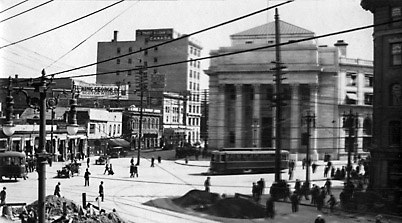
Two new Manitoba icons were also unveiled in 1919. The Timothy Eaton Statue and The Golden Boy. Rural electrification was underway with Portage la Prairie the first town to be connected to the central power grid from Winnipeg.

That a bit of what life was like in Winnipeg in 1917 - 1919.

Tuesday, March 3

Context: The 1917 The Russian Revolution

Some labour leaders looked to the success of the Revolution as a major motivation TO strike. Some business leaders looked to the success of the Revolution as a major motivation to have to crack down hard on the movement.

Overview Essay: The Russian Revolution by P Litwin

Video: Turning Points In History - 1917 The Russian Revolution (24 Min)