Sunday, May 17

May 17 - Citizens' Committee of 1000

May 17, 1919 - The Citizens' Committee of One Thousand is set up by business leaders to counteract the Strike Committee.

Citizens' Committee of One Thousand, source.

The main goal of the 1000 is to provide essential services to the city while workers are off the job. In their first official statement they give themselves a wider task:

The Citizens Committee of Winnipeg has taken steps to form itself into a permanent organization for the purpose of arousing Dominion-wide interest in the necessity of upholding proper respect for the law and to combat the Bolshevistic propaganda which is being so industriously sown in Western Canada.

Official Statement

Volunteers "man" the pumps

Citizens' Committee HQ

Saturday, May 16

May 16 - New York Times : Winnipeg is Tied Up

From the N.Y. Times:

Friday, 16 May 1919

Today's Western Labour News proudly proclaims: Workers Back Strikers to the Limit. General Strike Overwhelmingly Supported.

On the front page of today's Free Press is a quote from Thomas Roden, president of the Toronto branch of the Canadian Manufacturers' Association. He made the comments about the Winnipeg situation at their annual meeting which took place yesterday.:

  " In the matter of the present strike of the metal trades, no sensible man can possibly sympathize with their demands. The position of the metal workers is one of the most extraordinary positions' ever taken, and can only be taken by people who are desperate to obtain some demand which they know to be unjust.

"The demand for an 8-hour day is only a play upon the sentiment of the times. It is true some trades
have an 8-hours day. The printing trades have an 8-hour day, but it means a 48-hour week to them.
These people want a 44-hour week, although it may be suicidal to Canadian-industry."

Friday, May 15

Thursday, 15 May 1919 - Day of Action

May 15, 1919, Winnipeg Tribune

7:00 am - As the night shift ends for 500 government telephone operators there are no workers to replace them. These women begin the Winnipeg General Strike four hours earlier than the 11:00 am call and communications within the city soon come to a stand still.

8:00 am - The Free Press hits the streets with a font page appeal from Mayor Gray to all citizens asking for for calm:


11:00 am - As scheduled, factories, office buildings, fire halls, workshops, retail outlets, garages begin to empty. By lunchtime, 94 unions walk of the job, approximately 25,000 employees.

Thursday, May 14

Wednesday, 14 May 1919 - Zero Hour is Near

The headline in the Free Press:


The Mayor and Premier express concern at the vote and meet today at 2 pm with representatives from labour and business to seek a compromise.

That meeting is unsuccessful and by the end of day Robinson was contacting senior representatives, such as the city electrician, to inform them that the strike was on:


Mayor Gray sends a lengthy telegram to the acting premier Sir Thomas White and Federal Labour Minister Gideon Robertson summing up the situation and requesting assistance:

Wednesday, May 13

Tuesday, 13 May 1919 - The Results

Though not all unions have cast their ballots yet, a majority have and the results of the strike vote are officially announced.

At the end of the Trades and Labour Council meeting, Alderman E. Robinson, who also happens to be the secretary of the Council, reads the following statement:

“A General Strike has been called of all organizations affiliated with the Trades and Labor Council.

The Strike will take effect at 11 o’clock on Thursday morning. Every organization but one has voted overwhelmingly in favour of strike, and the biggest strike in the history of Winnipeg will take place as above stated.

No exceptions are anticipated in this strike. All public Utilities will be tied up in order to enforce the principle of collective bargaining.”


Later it would be made public that the vote count was 11,000 to 500 in favour of action.

The mayor and premier are on-hand to hear the results.

Tuesday, May 12

May 12

The results are coming in and a majority of unions have so far voted in favour of strike: bricklayers; jewellery workers; electrical workers; pressmen. The only exception so far is the typographical union, on the request of it's international arm.

Voting will continue over the next two days.

Monday, May 11

Sunday, 11 May 1919 - Voting Day

Voting begins today for Winnipeg Trades Council members.

They are asked whether or not they support a general strike in sympathy to the building and metal trades.

Wednesday, May 6

Tuesday, 6 May 1919

The Winnipeg Trades and Labour Council announce that they will hold a city-wide strike vote of other organized workers on May 11th.

Saturday, May 2

Friday, 2 May 1919 - Metal workers set to go

The metal trades union have been negotiating since April for a nine hour working day and recognition of their trade union.

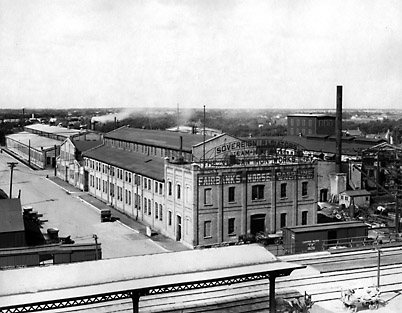
Vulcan Iron Works c 1920

It's rumored that the larger employers in town rejected their demands, while five smaller shops accepted. In the end, the large shops win the day.

Winnipeg's metal trades workers are set to join the building trades on the picket line.

Friday, May 1

Thursday, 1 May 1919

The first edition of the One Big Union Bulletin is published by the "One Big Union Provincial Executive of Manitoba". It gives a rundown of what was happening in the OBU movement in other North America cities and reminds Winnipeg workers that:

Now that the ballots are being distributed in Manitoba, let every
member of organized labor see to it that he casts his vote in order that a true
expression of the ideas of the rank and file can be registered, and let it be a
glorious success for the One Big Union.

To read the full bulletin.
For background on the vote see March 13 entry

Thursday, 1 May 1919 - Construction Workers Set to Go

Just after midnight the results of the builders' trades strike vote is announced: 1,199 in favour to 74 against. At 8 a.m. approximately 1,400 construction workers walk off the job.

Streetcar workers also vote in favour to strike, (900 to 79), but for the time-being will remain on the job.

Thursday, 1 May 1919

Showing that good fortune can be had in a bad situation, Ryan Agency offers Strike and Riot insurance on the front page of the Manitoba Free Press !

Thursday, April 30

30 April 1919

 April 30, 1919, Manitoba Free Press

Talks between the Winnipeg Building Trades Council and the Winnipeg Builders' Exchange fail.

Workers are looking for pay increases to make up for what was lost due to wartime inflation, about 20 cents per hour, depending on position. The Builders' Exchange presents a single proposal not open to negotiation. The increase presented is believed to be in the five to ten cent range.

A strike vote is held and the decision is to strike.

Tuesday, April 28

28 April 1919

Labour unrest continues in Manitoba. 

Civic workers meet with other labour groups in what the Brandon Sun calls “... the biggest gathering of labour ever held in the city.” 

"The general idea ... was that all the labour here should get into one big union, which would take in all classes of labourers and so unify the whole that they would have a great strength".

For more on Brandon’s 1919 labour unrest.

Friday, April 24

April 24

Both the metal and building trades unions present their demands to their respective employers.

The metal trades want a 17 to 30 cent per hour increase, depending upon position, and a 44 hour work week. The building trades want an increase of around 20 cents per hour with a 44 hour work week and recognition of their trade union.

Sunday, April 12

April 12

One of the many unemployed Veterans' parades in Winnipeg at the time.

Wednesday, April 1

April 1

As labour's militancy grew, so did the suspicions of government.

The federal government had the The Royal North-West Mounted Police involved in espionage:

"...by April, 1919 the R.N.W.M.P. had organized a highly successful undercover intelligence operation in western Canada. Secret agents and detectives had managed to penetrate every important radical union and political party. Some of them had acquired the confidence of union leaders. Their reports gave a detailed account of the activities of the radicals, their plans, speeches and movements. These were carefully scrutinized at the C.I.B. office in Regina and forwarded to Ottawa for the information of Rowell [the president of the Privy Council, and Minister in charge of the R.N.W.M.P.] and other cabinet ministers. The government was being fully informed, as it had requested."

Quote from S.W. Horrall and quoted in Canadian National Security: Legislations vs. Practices 1919-1946 by J. Bennet

Friday, March 13

March 13, 1919

The three-day Western Labour Conference begins in Calgary.


The main item discussed was the creation of "One Big Union." 

It was supported by many labour leaders as amalgamating all workers under one umbrella would allow for greater bargaining power and strike impact. 

It was a controversial proposal. Of course, the business community and government did not did not like the idea of an "all or nothing" labour force. Even within labour, there were many who were fiercely loyal to their respective trade unions and did not want to give them up.


On the first day of the conference R. J. Johns of Winnipeg, chairman of the policy committee, introduced a series of resolutions for the creation of O.B.U.. 

It was decided that workers would vote in June as to whether they wanted to join or not.

An advance issue of the Western Labour News was published on April 4, 1919 containing the conferences report of proceedings.

For more see maniobia.com: "The One Big Union."

Thursday, March 5

Context: The State of Labour


Labour unrest did not come to Winnipeg out oft eh blue. For years, labour action had been mounting in cities around the world, from Limerick to Liverpool, New York to Seattle.


 Source: Kealey, p 16

Vancouver already had a one-day general strike in August 1918. February 1919's Seattle General Strike, (also), saw 100,000 people walk off the job and is actually considered the first "general strike" the U.S. ever had. Hundreds of strikes also took place in Canada in the years preceding 1919.


1906 streetcar strike F36b


Some say that the seeds of the General Strike were sown in 1906 during the bitter Winnipeg Streetcar Strike (page 15). Other industries such as textiles and metal workers struck on and off as well.
The largest labour action prior to the General Strike came in May 1918 after city council refused to meet wage demands by civic employees. Streetcar workers, watermen, telephone operators and the like walked off the job. Other unions, such as construction workers, struck in sympathy. Before others could join in a settlement was reached.


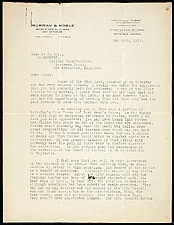
The letter above is between two labour leaders discussing that 1918 strike and the state of labour in the city at the time. Another great source is Manitobia.com "Roots of the Strike" which contains other pamphlets and photos leading up to 1919.