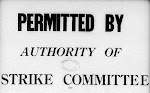
As they promised at the beginning of the strike, the Imperial Veterans did not meet until a week after the end date of the strike.
Thursday, July 2
2 July 1919 - War Vets Resume Meetings
As they promised at the beginning of the strike, the Imperial Veterans did not meet until a week after the end date of the strike.

Wednesday, July 1
Arrest Watch - Raw Data
Over the weeks a number of people were arrested - perhaps hundreds.
I am creating an 'arrest watch' list from names taken from articles trying to match them up with their outcomes. Due to the numbers I will not reference every article that I found them in but here is a sampling of some of them:
 Manitoba Free Press June 25, 1919
 20 June 1919
 Telegram Jun 27, 1919
 June 17, 1919
 Winnipeg Telegram June 18, 1919
 Winnipeg Telegram June 23, 1919
 Manitoba Free Press June 23, 1919
I am creating an 'arrest watch' list from names taken from articles trying to match them up with their outcomes. Due to the numbers I will not reference every article that I found them in but here is a sampling of some of them:
 Manitoba Free Press June 25, 1919
 20 June 1919
 Telegram Jun 27, 1919
 June 17, 1919
 Winnipeg Telegram June 18, 1919
 Winnipeg Telegram June 23, 1919
 Manitoba Free Press June 23, 1919
1 July 1919 - 'The Mathers Commission'
The Commission to Inquire into and Report upon Industrial Relations in Canada, often referred to as the 'Mathers Commission' was struck in March 1919 by the Borden Government. It's chair was Thomas Graham Mathers was Chief Justice of Manitoba.
 The Commission's mandate was to inquire and report back on the following:
(1) To consider and make suggestions for securing a permanent improvement in the relations between employers and employees.
(2) To recommend means for ensuring that industrial conditions affecting relations between employers and employees shall be reviewed from time to time by those concerned, with a view to improving conditions in the future. (source)
Between April and June 1919 the Commission visited 28 municipalities and heard from 486 witnesses. The Winnipeg dates were May 10 - 13, 1919. The labour side wanted little part in a government inquest and there was not a great deal of representation. The side of industry, however, took advantage of the hearings to air their grievances. (see Conflict in Winnipeg p 107)
Of course the Commission was still in process when the Winnipeg General Strike took place. Its final report was ready and tabled in the House on July 1, 1919.
Their findings included the fact that the 'chief causes of discontentment were: unemployment, the rising cost of living, long working hours, lack of collective bargaining rights, the housing shortage, restrictions on freedom of speech and the press, and unequal educational opportunities'. (source)
Related:
The Commission Report (also printed as a supplement to the Labour Gazette, July 1919) is not yet available online.
Photo source and more detailed bio of Mathers:
The Court of Queen's Bench of Manitoba, 1870-1950: a biographical history
 The Commission's mandate was to inquire and report back on the following:
(1) To consider and make suggestions for securing a permanent improvement in the relations between employers and employees.
(2) To recommend means for ensuring that industrial conditions affecting relations between employers and employees shall be reviewed from time to time by those concerned, with a view to improving conditions in the future. (source)
Between April and June 1919 the Commission visited 28 municipalities and heard from 486 witnesses. The Winnipeg dates were May 10 - 13, 1919. The labour side wanted little part in a government inquest and there was not a great deal of representation. The side of industry, however, took advantage of the hearings to air their grievances. (see Conflict in Winnipeg p 107)
Of course the Commission was still in process when the Winnipeg General Strike took place. Its final report was ready and tabled in the House on July 1, 1919.
Their findings included the fact that the 'chief causes of discontentment were: unemployment, the rising cost of living, long working hours, lack of collective bargaining rights, the housing shortage, restrictions on freedom of speech and the press, and unequal educational opportunities'. (source)
Related:
The Commission Report (also printed as a supplement to the Labour Gazette, July 1919) is not yet available online.
Photo source and more detailed bio of Mathers:
The Court of Queen's Bench of Manitoba, 1870-1950: a biographical history
Sunday, June 28
Saturday, 28 June 1919
The Winnipeg Telegram publishes its final strike edition. Interestingly, under the headline "World Rejoices at Peace", it carries a story about the formal end of the war and a call for 'peace' in the city as well:


"Now that the strike is officially over let us make reasonable haste to make sure that it is over at the earliest possible moment".

Saturday, June 27
Friday, 27 June 1919 - The Newsstand
The Western Labor News returns to the newsstand !
 - Starts with a front page story detailing why the strike was called off. The majority of the Strike Committee felt that an absolute victory at this point was 'hopeless'.
- The paper appeals for funds to continue operating.
Winnipeg Telegram Strike Edition
- Man accidentally shot during riot seeks restitution from city.
- In an editorial, they warn that there is 'still danger'.
 - Streetcars are ready for service.
- It's expected that 180 of the 220 members of the police force will be reinstated. The other 40 are still being considered.
Manitoba Free Press
 - Reports that while one committee has wound down ...

... the Citizens Committee is continuing it's work assisting other centres in the West still having labour disputes.
 - Starts with a front page story detailing why the strike was called off. The majority of the Strike Committee felt that an absolute victory at this point was 'hopeless'.
- The paper appeals for funds to continue operating.
Winnipeg Telegram Strike Edition
- Man accidentally shot during riot seeks restitution from city.
- In an editorial, they warn that there is 'still danger'.
 - Streetcars are ready for service.
- It's expected that 180 of the 220 members of the police force will be reinstated. The other 40 are still being considered.
Manitoba Free Press
 - Reports that while one committee has wound down ...
... the Citizens Committee is continuing it's work assisting other centres in the West still having labour disputes.
Friday, June 26
Thursday, 26 June 1919 - The Newsstand
The Enlightener
- Reports that indignation is being expressed by many over the calling off of the strike and that they will "demand a statement from their representatives on the general Strike Committee as to their high handed action in calling off the General Strike."
- Railway workers, late comers to the strike, will be voting on a motion to keep the strike going.
 Winnipeg Telegram Strike Edition
- Reports that strike leaders will instead focus on constitutional means to get their way by running more Labor candidates in the next civic election.
- Acting Chief Newton's reorganization of the police force is coming along and will be a "model force" once completed. Former police can apply for their jobs and each will be considered on a case by case basis.
The New York Times

- Reports that indignation is being expressed by many over the calling off of the strike and that they will "demand a statement from their representatives on the general Strike Committee as to their high handed action in calling off the General Strike."
- Railway workers, late comers to the strike, will be voting on a motion to keep the strike going.
 Winnipeg Telegram Strike Edition
- Reports that strike leaders will instead focus on constitutional means to get their way by running more Labor candidates in the next civic election.
- Acting Chief Newton's reorganization of the police force is coming along and will be a "model force" once completed. Former police can apply for their jobs and each will be considered on a case by case basis.
The New York Times

Thursday, June 25
Arrest Watch - 25 June 1919
Over the course of the strike a number of arrests were made. The two main batches were on June 17/18 and June 21/22. The proceedings of these trial will be followed daily along with other events.
A summary of all those arrested will appear here in a couple of days.
For June 25:
 Manitoba Free Press
A summary of all those arrested will appear here in a couple of days.
For June 25:
 Manitoba Free Press
Wednesday, 25 June 1919 - The Newsstand
Today's official labour paper is The Enlightener and the Front Page says it all:
 The Winnipeg Telegram Strike Edition
- On their front page calls the strike "a miserable failure"

Then spend a bit of time correcting items from yesterday:
- Norris publicly denies that a strike commission, as reported yesterday.
- Justice Robson denies knowledge that he has been appointed to the commission
Winnipeg Free Press
Is a little less angry-sounding in their main editorial. They call it a waste of one of the nicest summers in memory and:


 The Winnipeg Telegram Strike Edition
- On their front page calls the strike "a miserable failure"

Then spend a bit of time correcting items from yesterday:
- Norris publicly denies that a strike commission, as reported yesterday.
- Justice Robson denies knowledge that he has been appointed to the commission
Winnipeg Free Press
Is a little less angry-sounding in their main editorial. They call it a waste of one of the nicest summers in memory and:
"...if the citizens - all the citizens - of this town could get a human view of each other, if they could see the children swelter and suffer because of adult foolishness and wrongheadedness - the citizens of Winnipeg might agree to damn the strike and abolish it forthwith"

Wednesday, 25 June 1919 - Western Impact
With the announcement of the end of the Winnipeg General Strike, sympathetic strikes in Winnipeg began to loose steam.
In Saskatoon and Victoria they are waiting for official word. Edmonton would call their strike off for June 27th. Calgary's had already begun to peter out and ended last night. Brandon tried to keep it going with another strike vote tomorrow but by the end of June they, too, ran out of steam.
 Free Press June 25 1919
In Saskatoon and Victoria they are waiting for official word. Edmonton would call their strike off for June 27th. Calgary's had already begun to peter out and ended last night. Brandon tried to keep it going with another strike vote tomorrow but by the end of June they, too, ran out of steam.
 Free Press June 25 1919
Wednesday, June 24
Tuesday , 24 June 1919 - The Newsstand
Winnipeg Telegram Strike Edition
- Reports that the death toll is rising from the riots. Steve Schezerbanowicz, shot in the legs, has died from gangrene infection at General Hospital. From East Selkirk, Schezerbanowicz has been residing at 232 Lizzie Street during the strike.
There is also the story of Robert Murdock, a worker at the pumping plant, was severely beaten by a group of up to 30 men. He was found in Cecil Rhodes School yard and brought to General Hospital. The story references that this is not the first mass attack on a worker and implies that strikers may be behind it.
- Justice H.A. Robson is believed to be named to the commission looking into the causes of the strike,something that labour had asked for. Ottawa still stands frim on NOT dealing with the matter any further until the strike is called off.
- The editorial supports the "suppressing" of the Western labor News after seeing yesterday's edition. Many stories were printed merely to incite people intor rioting. They were even advertising illegal meetings !
The Western Star
Is the labour paper today after the Labor News was shut down. The below notice was sent and acting editor J.S. Woodworth, who was sitting in for the arrested Ivens, was himself arrested on Main Street near the McLaren Hotel.
 - This is the final eddition that had them cut off.
- A defence fund has been created for those arrested.
- Reports that the death toll is rising from the riots. Steve Schezerbanowicz, shot in the legs, has died from gangrene infection at General Hospital. From East Selkirk, Schezerbanowicz has been residing at 232 Lizzie Street during the strike.
There is also the story of Robert Murdock, a worker at the pumping plant, was severely beaten by a group of up to 30 men. He was found in Cecil Rhodes School yard and brought to General Hospital. The story references that this is not the first mass attack on a worker and implies that strikers may be behind it.
- Justice H.A. Robson is believed to be named to the commission looking into the causes of the strike,something that labour had asked for. Ottawa still stands frim on NOT dealing with the matter any further until the strike is called off.
- The editorial supports the "suppressing" of the Western labor News after seeing yesterday's edition. Many stories were printed merely to incite people intor rioting. They were even advertising illegal meetings !
The Western Star
Is the labour paper today after the Labor News was shut down. The below notice was sent and acting editor J.S. Woodworth, who was sitting in for the arrested Ivens, was himself arrested on Main Street near the McLaren Hotel.
 - This is the final eddition that had them cut off.
- A defence fund has been created for those arrested.
Tuesday, June 23
Monday, 23 June 1919 - The Newsstand
Western Labour News
- Is Defiant. The headline screams: STRIKE UNBROKEN
- Outlines their version of what happened on Bloody Saturday
- Declares that the strike is ready to sizzle, not fizzle
The Winnipeg Citizen
- Does not publish again after June 20
The Winnipeg Telegram
- Has talk of additional arrests:
 -
-
- Is Defiant. The headline screams: STRIKE UNBROKEN
- Outlines their version of what happened on Bloody Saturday
- Declares that the strike is ready to sizzle, not fizzle
The Winnipeg Citizen
- Does not publish again after June 20
The Winnipeg Telegram
- Has talk of additional arrests:
 -
-

Monday, June 22
Bloody Saturday - The Fallout
- The immediate aftermath was nearly 100 arrests (this partial list from Manitoba Free Press 23 June 1919):
 This is a list of those injured enough to be admitted to General Hospital (Telegram, 23 June). The lone immediate death was that of Mike Skodelik (later identified as Mike Sokolowski) of Henry Avenue. Steve Schezerbanowes of East Selkirk who was shot in the legs would die days later from infection.
 - Minister Robertson declares that the Federal government will not resume negotiations until the strike is called off. He also distances the feds from what took place: "It was purely an action of the provincial and civic authorities" he tells the Telegram.
 - Streetcar service was called off after the riot in what the Telegram called a "grim mistake" as it shows a sign of weakness.
 This is a list of those injured enough to be admitted to General Hospital (Telegram, 23 June). The lone immediate death was that of Mike Skodelik (later identified as Mike Sokolowski) of Henry Avenue. Steve Schezerbanowes of East Selkirk who was shot in the legs would die days later from infection.
 - Minister Robertson declares that the Federal government will not resume negotiations until the strike is called off. He also distances the feds from what took place: "It was purely an action of the provincial and civic authorities" he tells the Telegram.- Streetcar service was called off after the riot in what the Telegram called a "grim mistake" as it shows a sign of weakness.
Bloody Saturday - In the Mayor's Words
This statement was issued the night of Bloody Saturday and published Monday June 23rd in the Telegram:


Sunday, 22 June 1919 - The International Newsstand
Seattle Post-Intelligencer, 22 June 1919

 New York Times, 22 June 1919
 - Also an in-depth feature "Bolshevism in Winnipeg"
 Chicago Tribune, Front Page:
Winnipeg, Man., June 21.- Winnipeg, strike torn since May 15, is under martial law tonight. After bloody fighting this afternoon between thousands of strikers and the city and provincial police, in which one man was killed, several injured probably fatally, and more than a score hurt...
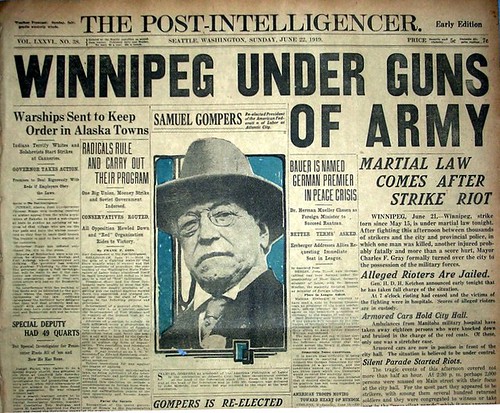
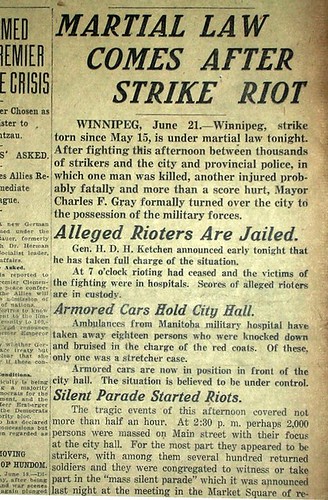 New York Times, 22 June 1919
 - Also an in-depth feature "Bolshevism in Winnipeg"Chicago Tribune, Front Page:
Winnipeg, Man., June 21.- Winnipeg, strike torn since May 15, is under martial law tonight. After bloody fighting this afternoon between thousands of strikers and the city and provincial police, in which one man was killed, several injured probably fatally, and more than a score hurt...
Sunday, June 21
Saturday Afternoon, 21 June 1919 - Bloody Saturday Begins
Click on images for source information. Please click on images for source.
 10:30 am: A delegation from the pro-strike Veterans meet with Mayor Gray and Federal Labour Minister Gideon Robinson at the Royal Alexandra Hotel on Main Street to try to reach a compromise about today's planned march.
The Veterans want to march from City Hall to the Royal Alex where they hope Robertson will address them and then on to the Citizens' Committee headquarters.
The Mayor advises that such a march is against his proclamation of a few days before and that force could be used to break it up. The delegation would only agree to call off the march if the strike was ended by 2 pm and that the streetcars scheduled to run today are taken off-track.
No resolution is reached.
 1:45 pm: Police Chief Newton contacts Mayor Gray at the hotel to say that a large crowd is gathering.
 The mayor advises Newton to inform RNWMP Commissioner Perry to have his 'specials' and Perry's mounties on the streets.
 2:30 pm: At Main and William a large crowd is gathered waiting to form the march.
 A streetcar travels from the north toward the crowd. Angered by the gesture, as streetcar service was shut down due to the strike, they surround it but the car makes it though.

 Moments later, another streetcar traveling north is not so lucky. It is pulled from the wires and trashed. Unable to overturn it, the streetcar is set on fire.
 Meanwhile, the NWMP were set up near Portage and Main and start off on their first, slow, pass through the crowd. Some insults are hurled and a missile or two thrown but it is uneventful.
On the return pass from James Street back toward Portage, one officer's horse trips on the bumper of the trashed streetcar. The officer is dragged and a member of the crowd begins to attack him. At this point officers draw their weapons.
 2:35 pm: Mayor Gray, looking on from the balcony at City Hall, reads the riot act and gives the crowd 30 minutes to depart. As he turns to go back inside, the sound of the first shot is heard - it is believed that an RNWMP officer fired a warning volley in the air.
 At that point, chaos breaks out. Some in the crowd are frightened and stampede for safety. Some fights break out between strikers and policemen, missiles are hurled at those on horseback and more shots are fired.
 2:45 pm: The Mayor leaves for Fort Osborne Barracks to ask Ketchen to send in the militia consisting of cavalry and motorized machine gun units.

Slowly, but surely, the troops would clear the streets. A combination of military, special constables and RNWMP would stay on guard until midnight.
That day there were a number of people shot and injured and scores arrested, the full extent of which would not be known until late in the day.
Subscribe to:
Posts (Atom)